
Ductwork Repair and Sealing in Ypsilanti and Southeast Michigan
Rooms that never get comfortable, a furnace that trips its limit, dust that never ends: half the time the equipment is fine and the ducts are not. We find the leaks and fix them.
The ductwork in a Southeast Michigan house is usually older than every piece of equipment attached to it and has never once been looked at. A 1950s ranch in Westland or Garden City has a sheet-metal trunk along the basement ceiling with branch runs to each room and returns that are nothing more than the space between two floor joists with a sheet of metal nailed underneath. A 1990s colonial in Canton or Pittsfield Township has a metal trunk with flex duct branches stapled between trusses in the attic and a single return in the upstairs hall. Both leak. Field studies put typical duct leakage at 20 to 30 percent of the air the blower moves, and every bit of that is DTE gas or electricity spent heating or cooling a basement, an attic or a wall cavity instead of a bedroom. Temprasure repairs and seals ductwork across Washtenaw and western Wayne County, and it is the fix for a lot of complaints that get blamed on the furnace.
The complaints are consistent. One room is always five degrees off. The upstairs is hot in summer and the basement is the only comfortable place in the house. The furnace runs for ten minutes and shuts off on its high limit because the return cannot bring back enough air. The air conditioner freezes every July for the same reason. The house is dusty a week after cleaning because a return in the basement is pulling air from the crawlspace through an open joist bay. The duct that fed the back bedroom came apart years ago when someone ran a cable, and it has been heating the ceiling of the basement ever since. We hear every one of those weekly, and we start with a static pressure reading and a look at the ducts before anyone talks about replacing equipment.
Repair means several things depending on what we find. A disconnected or crushed run gets reconnected or replaced. A trunk joint that was never sealed gets mastic, which is a paste applied by brush that cures hard and does not peel the way tape does. Flex duct that sags between trusses and kinks at every turn gets supported or replaced with a shorter, straighter run. A return that is pulling from the wrong place gets sealed at the joist bay and rerouted. An undersized return, which is the single most common cause of high static pressure in the houses we see, gets a second return or a larger grille and a filter cabinet that does not choke the blower. Where the leakage is spread across hundreds of small joints throughout the system, an aerosol sealing process of the Aeroseal type, which pressurizes the ducts and seals leaks from the inside, does what no amount of mastic can reach, and we can arrange it for houses where the leakage justifies it.
We measure before and after. Static pressure across the system tells us whether the blower is fighting the ducts; a register-by-register airflow check tells us which runs are starving; and a comparison after the repair proves the fix did something. That matters because duct repair is easy to oversell. Not every house needs sealing, and some houses with one disconnected run and one undersized return are fixed in an afternoon. We tell you what we found, what each fix does, and which items are optional.
Duct repair is often the best money a homeowner spends on comfort, because it makes the equipment already in the basement do what it was supposed to. It is also what makes a new furnace or air conditioner perform when the time comes, which is why we check the ducts on every installation estimate.
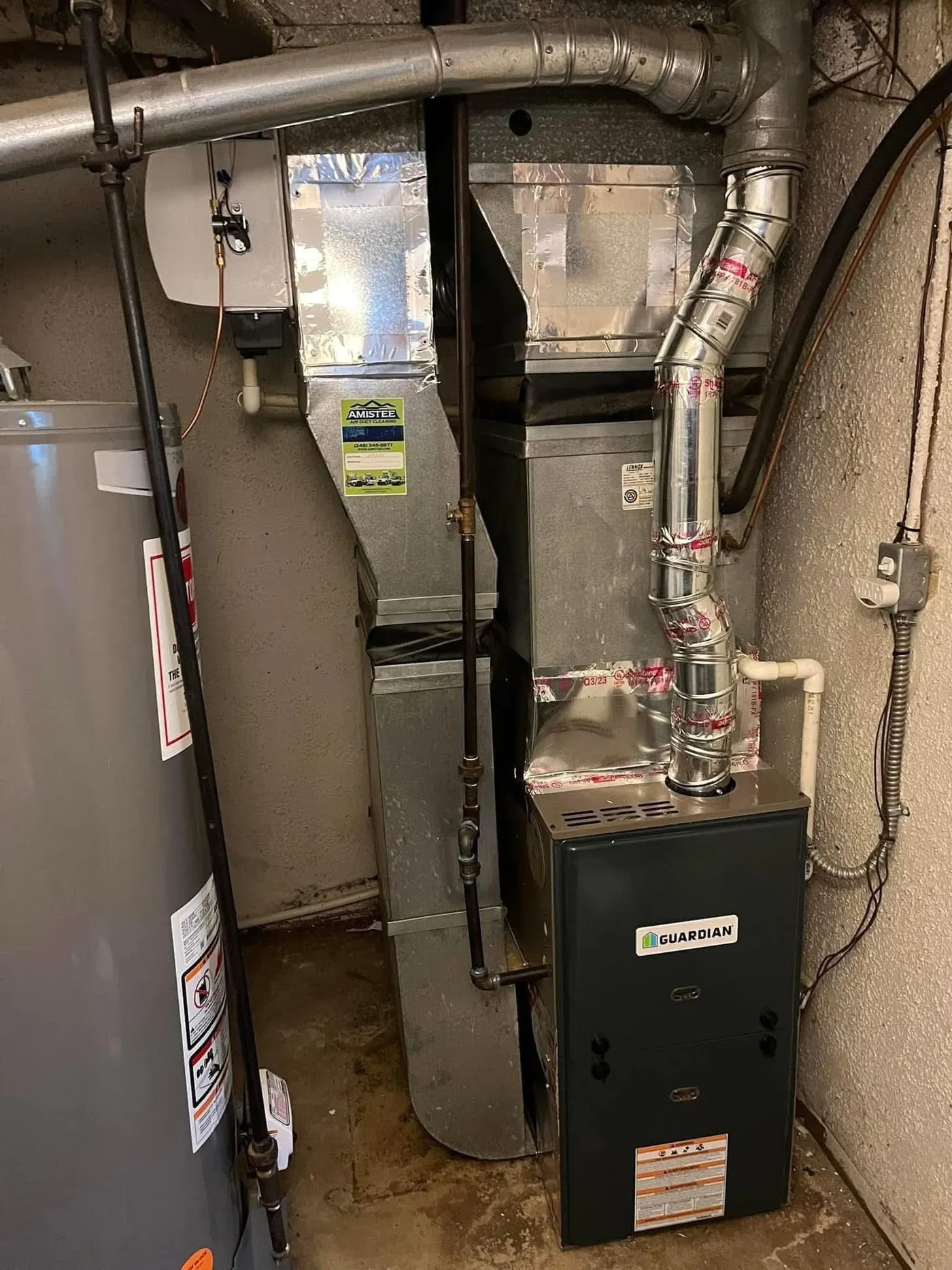
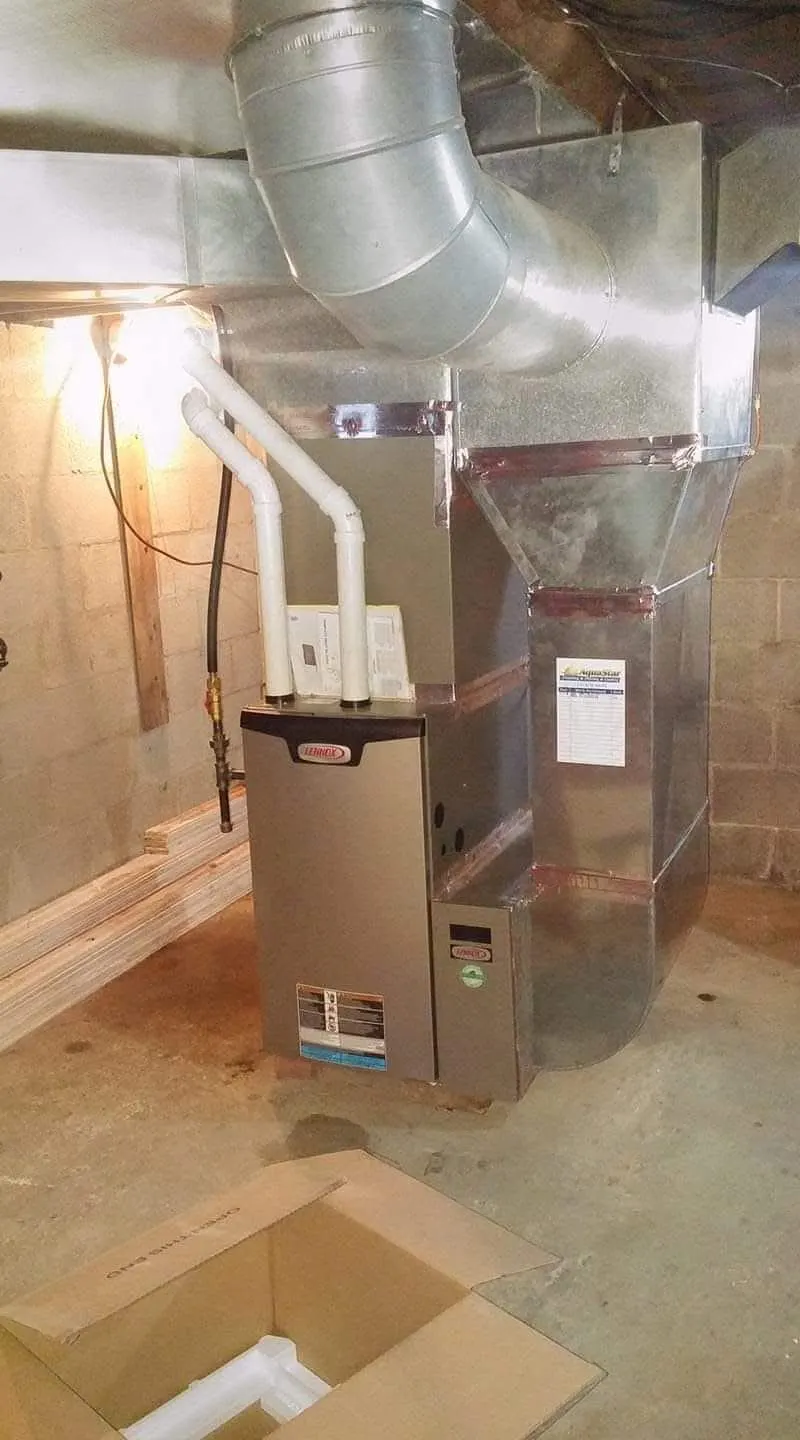
Duct Repair & Sealing work we have photographed
Signs it is time to call
One room is always too hot or too cold
A disconnected branch, a crushed flex run, a damper closed behind a wall, or a run that was never sized for the room. The thermostat satisfies while that room waits.
Furnace trips its high limit or AC freezes
Both are airflow failures. An undersized or blocked return cannot deliver enough air across the heat exchanger or coil, and the equipment protects itself by shutting down or icing up.
Dust that comes back within days
A leaky return in the basement or attic pulls unfiltered air from the joist bays and insulation into the system and delivers it to every room.
Whistling or rattling at registers
High static pressure whistles at restricted grilles. Rattling at a boot means the duct is loose from the register or a joint upstream has let go.
Basement or attic is warmer than it should be
A heated attic in January or a cool basement ceiling in July means supply air is leaving the ducts before it reaches the rooms.
Bills high for the size of the house
Twenty to thirty percent leakage means the system runs a quarter longer to do the same work. It shows up on the DTE bill and on the equipment's life.
Visible gaps, tape or disconnected runs
Duct tape peeling off joints in the basement, a branch hanging loose, flex crushed under stored boxes in the attic. If you can see it, it is leaking.
Musty smell when the system runs
A return pulling from a damp crawlspace or a Michigan basement delivers that air to the living space every cycle.
How the visit goes
Describe the comfort problem
Which rooms, which seasons, what the equipment does. That tells us whether we are looking for a single failed run or a system-wide leakage and return problem.
Measure static pressure and airflow
Total external static across the furnace, then airflow at each register and return. The numbers show where the air is going and whether the blower is fighting the ducts.
Inspect every accessible duct
Basement trunk, branches, boots, returns and joist pans; attic flex runs and plenums; crawlspace runs where they exist. We photograph what we find and show you.
Quote the fixes individually
Reconnect this run, add a return here, seal the trunk joints, replace that flex. Each item priced flat so you can see what is essential and what is optional.
Repair and seal
Mastic on joints, new hangers and supports, proper connections at boots and takeoffs, insulation on attic and crawlspace runs, a larger return and filter cabinet where needed.
Re-measure and compare
Static pressure and register airflow after the work, next to the before numbers, so you know what the repair accomplished.
What this covers
- Static pressure measurement across the furnace and coil
- Register and return airflow survey
- Reconnection of separated branch runs and boots
- Replacement of crushed, kinked or torn flex duct
- Mastic sealing of trunk joints, takeoffs, seams and plenum connections
- Sealing and lining of panned joist-bay returns
- Additional return air drops where the system is return-starved
- Filter cabinet upgrade from a one-inch slot to a media cabinet
- Attic and crawlspace duct insulation and support
- Balancing damper installation and adjustment
- Register and grille replacement where the opening restricts airflow
- Aerosol duct sealing coordination for whole-system leakage
- Before-and-after readings documented for you
How pricing works
Duct repair starts with a flat dispatch fee that covers the visit, the static pressure and airflow measurements, and a full inspection of the accessible ductwork. When you approve repairs, that fee is credited toward the work. Each repair item is quoted as its own flat price, so reconnecting a run, sealing the trunk, adding a return or replacing a flex branch is a known number before we start, and you can approve some items and defer others.
A single disconnected run or a loose boot is a small job finished in an hour. Sealing an entire basement trunk system, adding returns and replacing attic flex is a day or more and is priced accordingly. Aerosol sealing for a whole house is quoted separately after we measure the leakage and only when the numbers justify it; many houses are fixed well short of that.
We do not charge overtime for evenings or weekends, and duct work is often scheduled at whatever time keeps the house livable.
From the people we have helped
★★★★★Temprasure is one of the best-managed companies I've ever come into contact with. Not only did Al do a great job but he did so in a timely manner. He worked as if it was his home in need. I would recommend him to anyone who has heating and cooling needs.
★★★★★Al & Co. came out and took very good care of me and my family. He showed up within an hour of me making contact and was able to diagnose and take care of the problem quickly and for reasonable pricing.
★★★★★Al is very polite and professional. Is willing to answer any questions you may have. I would recommend Temprasure to 10/10 people looking for HVAC work.
Questions we hear most
How do I know if my ducts are the problem and not the furnace?
Static pressure. If the total external static is well above what the blower is rated for, the ducts are restricting the system and the furnace or AC is a victim, not the cause. We measure it on the first visit, and it takes ten minutes.
What is the most common duct problem you find?
Undersized return air, by a wide margin. Houses from the 1950s through the 2000s were built with returns sized for the original furnace and never enlarged. A single hallway return on a two-story colonial is the classic case.
Is duct tape a real repair?
No. Cloth duct tape dries out and peels within a couple of years, which is why so many basements have strips of it hanging off the trunk. We seal with mastic, which cures hard, or with UL 181 foil tape at connections where mastic does not apply.
What is Aeroseal and do I need it?
An aerosol process that pressurizes the ducts and injects a sealant that collects at leak points from the inside. It reaches leaks inside walls and floors that no one can get to by hand. It is valuable where leakage is spread throughout the system; it is unnecessary where the problem is one disconnected run and an undersized return. We measure first.
Can you fix the hot upstairs in my two-story?
Usually. The upstairs runs in most colonials are long, often through an unconditioned attic, and the return is undersized. Sealing and insulating the attic runs, adding an upstairs return and balancing the dampers gets most houses within a couple of degrees floor to floor.
What is a panned return?
A return made by nailing sheet metal across the bottom of a floor joist bay so the space between joists carries the air. Common in 1950s and 60s ranches. They leak at every joist, pull air from the basement and crawlspace, and are the source of a lot of dust and musty smell. We seal and line them or replace them with real duct.
Will sealing the ducts lower my bill?
If the ducts are leaking a meaningful amount, yes, because the system runs less to do the same job. The bigger benefits most people notice first are even temperatures and less dust.
Do I need a permit for duct repair?
Repairs and sealing do not require a permit in Washtenaw or Wayne County. Adding or relocating ductwork as part of a new system installation is covered under that system's mechanical permit.
Should I have the ducts cleaned instead?
Cleaning removes what is in the ducts; it does not stop what is getting in. If the dust is coming from leaky returns, cleaning is a temporary fix. Seal first, then clean if there is still a reason to.
Ductwork Repair near you
Local pages for each community we serve, with the housing and equipment details that matter there.
- Duct Repair & Sealing in Ypsilanti
- Duct Repair & Sealing in Ypsilanti Township
- Duct Repair & Sealing in Ann Arbor
- Duct Repair & Sealing in Pittsfield Township
- Duct Repair & Sealing in Superior Township
- Duct Repair & Sealing in Saline
- Duct Repair & Sealing in Dexter
- Duct Repair & Sealing in Chelsea
- Duct Repair & Sealing in Milan
- Duct Repair & Sealing in Scio Township
- Duct Repair & Sealing in Ann Arbor Township
- Duct Repair & Sealing in Lodi Township
- Duct Repair & Sealing in York Township
- Duct Repair & Sealing in Augusta Township
- Duct Repair & Sealing in Whittaker
- Duct Repair & Sealing in Willis
- Duct Repair & Sealing in Salem Township
- Duct Repair & Sealing in Whitmore Lake
- Duct Repair & Sealing in Canton
- Duct Repair & Sealing in Belleville
- Duct Repair & Sealing in Van Buren Township
- Duct Repair & Sealing in Sumpter Township
- Duct Repair & Sealing in Romulus
- Duct Repair & Sealing in Westland
- Duct Repair & Sealing in Wayne
- Duct Repair & Sealing in Inkster
- Duct Repair & Sealing in Garden City
- Duct Repair & Sealing in Plymouth
- Duct Repair & Sealing in Plymouth Township
- Duct Repair & Sealing in Northville
- Duct Repair & Sealing in Livonia
- Duct Repair & Sealing in New Boston
- Duct Repair & Sealing in Dundee
- Duct Repair & Sealing in South Lyon
Related services
Read before you call
- Ductwork Leaks in Older Michigan Homes: Where They Hide and What They Cost You
- Upstairs Hot, Downstairs Cold: Fixing Uneven Temperatures in a Michigan Two-Story
- Why Is My House So Dusty? Ductwork, Filters and the Real Sources of Indoor Dust
- Furnace Filter Sizes and MERV Ratings: Picking the Right One
- Michigan Basements and HVAC: Moisture, Rust, Sump Pits and What They Do to Your Furnace
Ductwork Repair, done right the first visit
Call or text (313) 701-9471 and tell us what the system is doing. We'll give you a real arrival window and a flat-rate quote before any work starts.